

SharePoint Mentor Curated Articles
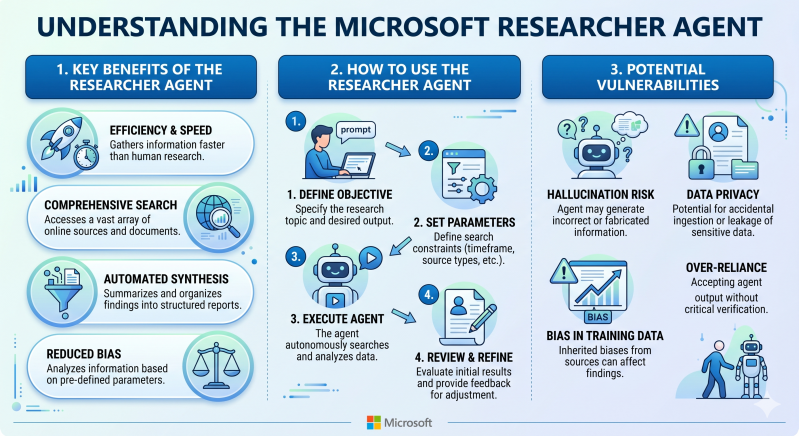
Understanding the Microsoft Researcher Agent
The Microsoft Researcher Agent is a sophisticated AI-driven tool designed to streamline the process of gathering, synthesizing, and analyzing vast amounts of information from diverse sources. By leveraging advanced large language models (LLMs) and specialized search capabilities, it functions as an autonomous or semi-autonomous research assistant capable of producing high-quality reports and insights.
Core Benefits of the Researcher Agent
The integration of a Researcher Agent into professional and academic workflows offers several transformative advantages:
- Efficiency and Speed: The agent can scan thousands of documents and web pages in a fraction of the time it would take a human researcher, significantly accelerating the discovery phase of a project.
- Broad Information Synthesis: It excels at connecting disparate data points across different domains, providing a more holistic view of a subject.
- Consistency: Unlike human researchers who may suffer from fatigue or bias, the agent applies the same rigorous parameters to every search and analysis.
- Automated Formatting: The agent can automatically structure its findings into structured reports, complete with citations and summaries, saving substantial administrative time.
How to Use the Researcher Agent
- Implementing the Microsoft Researcher Agent typically involves a series of steps to ensure the output aligns with the user's specific needs:
- 1. Defining the Research Objective - Success begins with a clear prompt. Users must define the scope, the specific questions to be answered, and the desired depth of the final output. For example, instead of "research AI," a better prompt would be "Research the impact of generative AI on healthcare diagnostics from 2022 to 2024."
- 2. Setting Parameters and Constraints - Users can often specify the types of sources to prioritize (e.g., academic journals, news outlets, or internal company documents) and set exclusion criteria to filter out irrelevant data.
- 3. Reviewing and Refinement - The process is iterative. Users should review the initial drafts or summaries generated by the agent and provide feedback or additional instructions to narrow the focus or expand on specific interesting findings.
Potential Vulnerabilities and Risks
- While powerful, the Microsoft Researcher Agent is not without risks that users must proactively manage:
- Hallucination - The agent may generate facts, citations, or data points that appear plausible but are entirely fabricated.
- Data Privacy - If not properly configured, the agent might ingest or leak sensitive information during the research process.
- Bias Amplification - The agent may inadvertently mirror or amplify biases present in its training data or the sources it crawls.
- Over-Reliance - Users may accept the agent's output as "ground truth" without performing necessary verification, leading to errors in decision-making.
Conclusion
- The Microsoft Researcher Agent is a potent tool for the modern information age. By understanding its capabilities and maintaining a critical eye toward its potential pitfalls, users can leverage it to achieve unprecedented levels of productivity and insight.