

SharePoint Mentor Curated Articles
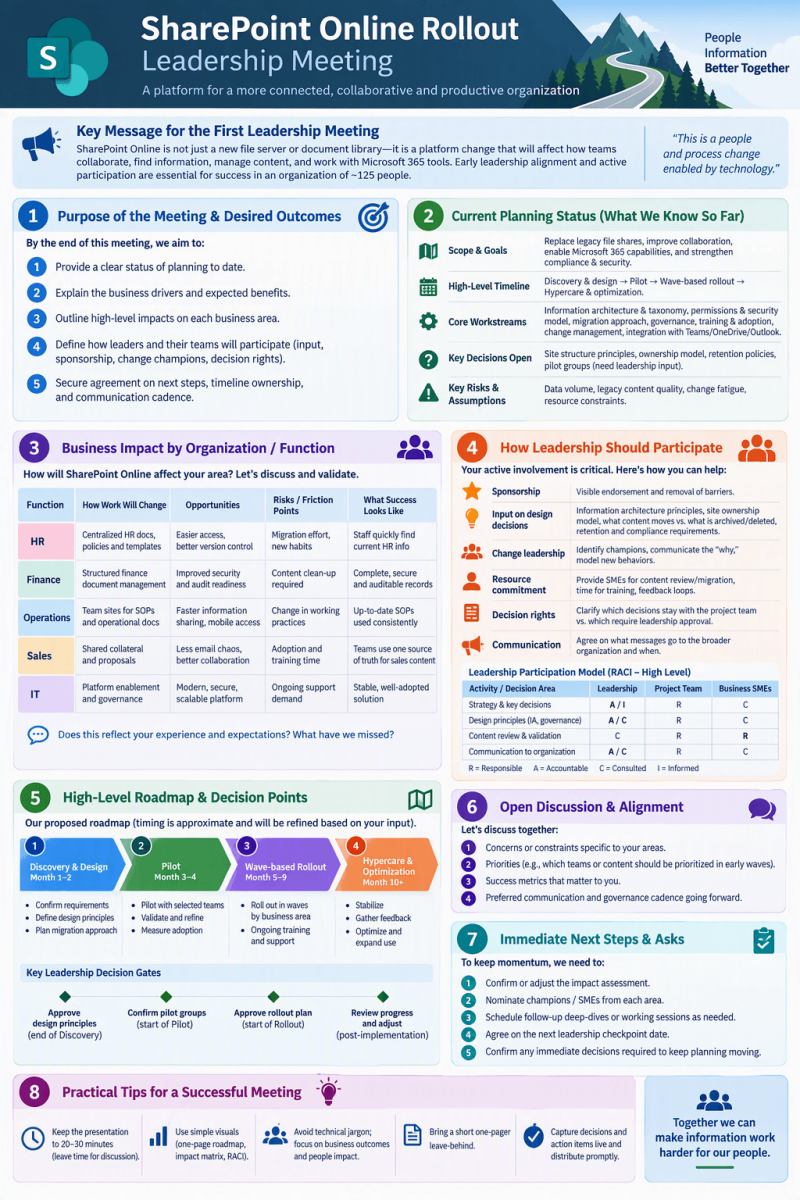
Key message for the first leadership meeting
SharePoint Online is not just a new file server or document library—it is a platform change that will affect how teams collaborate, find information, manage content, and work with Microsoft 365 tools. Early leadership alignment and active participation are essential for success in an organization.
1. Purpose of the Meeting & Desired Outcomes
- Provide a clear status of planning to date.
- Explain the business drivers and expected benefits.
- Outline high-level impacts on each business area.
- Define how leaders and their teams will participate (input, sponsorship, change champions, decision rights).
- Secure agreement on next steps, timeline ownership, and communication cadence.
2. Current Planning Status (What We Know So Far)
Share a concise, factual update:
- Project scope and goals (replace legacy file shares / improve collaboration / enable Microsoft 365 capabilities / compliance & security improvements, etc.).
- High-level timeline phases (discovery & design → pilot → wave-based rollout → hypercare & optimization).
- Core workstreams already identified: information architecture & taxonomy, permissions & security model, migration approach, governance, training & adoption, change management, integration with Teams/OneDrive/Outlook.
- Key decisions still open that require leadership input (e.g., site structure principles, ownership model, retention policies, pilot groups).
- Risks and assumptions already captured (data volume, legacy content quality, change fatigue, resource constraints).
Keep this section short—focus on facts and open questions rather than deep technical detail.
3. Business Impact by Organization / Function
Translate the platform change into business language for each major area (HR, Finance, Operations, Sales, IT, etc.):
- How work will change — move from departmental file shares or email attachments to structured team sites, document libraries with metadata, shared ownership, and integration with Teams.
- Opportunities — faster information discovery, better version control, reduced email attachment chaos, improved cross-team collaboration, stronger compliance posture, mobile access.
- Risks / friction points — temporary disruption during migration, need for new habits (metadata, check-in/out, co-authoring), potential resistance to centralized governance, training time required.
- What success looks like for their area (measurable or observable outcomes).
Present this as a discussion, not a monologue. Ask leaders to validate or correct the impact assessment for their teams.
4. How Leadership Should Participate
Be explicit about the ask:
- Sponsorship — visible endorsement and removal of barriers.
- Input on design decisions — information architecture principles, site ownership model, what content moves vs. what is archived/deleted, retention and compliance requirements.
- Change leadership — identify champions within their teams, communicate the “why,” model new behaviors.
- Resource commitment — subject-matter experts for content review/migration, time for training, feedback loops.
- Decision rights — clarify which decisions stay with the project team vs. which require leadership approval.
- Communication — agree on what messages go to the broader organization and when.
Offer a simple RACI or participation model so expectations are clear.
5. High-Level Roadmap & Decision Points
- Show a one-page view of phases with approximate timing and the key leadership decision gates.
- Emphasize that the plan will be refined based on their input from this meeting.
6. Open Discussion & Alignment
Facilitate conversation around:
- Concerns or constraints specific to their areas.
- Priorities (e.g., which teams or content should be prioritized in early waves).
- Success metrics that matter to leadership.
- Preferred communication and governance cadence going forward.
7. Immediate Next Steps & Asks
End with concrete actions:
- Confirm or adjust the impact assessment.
- Nominate champions / SMEs from each area.
- Schedule follow-up deep-dives or working sessions as needed.
- Agree on the next leadership checkpoint date.
- Confirm any immediate decisions required to keep planning moving.
Practical Tips for the Meeting Itself
- Keep the total presentation portion to 20–30 minutes so most of the time is discussion.
- Use simple visuals (one-page roadmap, impact matrix by department, participation RACI).
- Avoid deep technical jargon; frame everything in terms of business outcomes and people impact.
- Bring a short one-pager leave-behind summarizing the key points, open questions, and asks.
- Capture decisions and action items live and distribute them promptly afterward.