

SharePoint Mentor Curated Articles

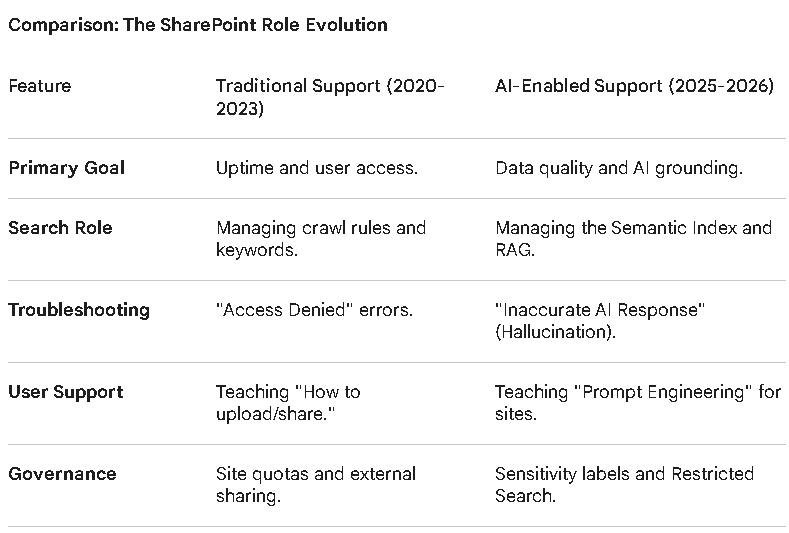
The deployment of Microsoft 365 Copilot and SharePoint AI agents represents a significant shift in the platform's 25-year history. For a support specialist in a large organization, the role is evolving from a technical administrator focused on infrastructure and simple troubleshooting to a Knowledge Architect focused on data hygiene and AI-readiness.
Here is how the landscape of your role is changing as we move through 2026:
1. From "Permissions Management" to "Data Access Governance"
In the pre-AI era, "oversharing" was a moderate risk; if a user didn't know a file existed, they likely wouldn't find it. With Copilot, if a user has access, the AI will find it and summarize it.
-
The Shift: You will spend less time manually granting access and more time using the SharePoint Admin Agent to identify and remediate "permission sprawl."
-
Focus: Implementing Sensitivity Labels and Restricted SharePoint Search to ensure Copilot only "sees" what it should.
2. The Rise of "SharePoint Skills" and Custom Agents
The role is moving toward "low-code/no-code" AI development. You aren't just supporting sites; you are teaching the AI how to behave.
-
SharePoint AI Skills: You will likely build and manage "Skills" (using the .md format) that teach AI how to perform repetitive tasks like contract reviews, metadata extraction, or document classification.
-
Declarative Agents: You will be responsible for creating specialized AI agents grounded in specific SharePoint libraries to provide "source-of-truth" answers for departments like HR or Legal.
3. Content Hygiene as the New "Storage Management"
Storage quotas are becoming secondary to Content Quality. If your SharePoint environment is full of "Version 1_FINAL_OLD.docx," Copilot will provide outdated answers.
-
The Shift: Your troubleshooting will move from "Why can't I access this?" to "Why is Copilot giving me an incorrect answer?"
-
Action: You will lead "Data De-cluttering" projects, using AI to identify inactive, ownerless, or redundant content that degrades the organization's Work IQ.
4. Evolution of the Support Interface
The way you perform your daily tasks is shifting to a natural language model.
-
Natural Language Admin: Instead of navigating complex menus in the Admin Center, you will use the Copilot in SharePoint Admin to run queries like: "Find all sites created in the last 30 days that have external sharing enabled and no sensitivity label."
-
Proactive Insights: The AI will surface proactive suggestions for site lifecycle management, flagging sites that have high activity but no clear owner.
5. Transition to "Strategic Mentor"
As manual tasks (like metadata tagging) are automated, your value shifts toward governance planning. Large organizations now require a "RACI" approach to AI deployment—determining who is responsible for the "Truth" of the data that fuels the AI. You become the bridge between IT Security and the business users who need AI to work correctly.
Given the scale of a large organization, are you seeing more resistance toward the "oversharing" risks, or is the focus primarily on the productivity gains of the new AI agents?