

SharePoint Mentor Curated Articles

Why the Board of Directors Must Lead the M365 & SharePoint Transformation, and Why treating it as an IT Project Invites Catastrophic Corporate Risk
Focus Environment: Microsoft 365 & SharePoint Cloud
1. Executive Summary
- The deployment of Artificial Intelligence (AI) solutions—specifically Microsoft Copilot and integrated Azure OpenAI models—within a company's Microsoft 365 (M365) and SharePoint environment represents a foundational shift in enterprise capability, risk posture, and corporate value creation. Historically, software rollouts have been delegated entirely to the Internal Corporate Information Technology (IT) department. However, treating enterprise generative AI deployment as a standard technology procurement or infrastructure upgrade is a fundamental governance error.
- Unlike traditional, deterministic software packages (such as an ERP system or email migration), generative AI models operating natively inside a company's data repositories possess auto-generative capabilities, direct links to intellectual property, and profound legal, cultural, and strategic vectors. If the IT department controls the AI strategy, the implementation will inherently optimize for mechanical uptime, license management, and basic software provisioning. It will fail to govern systemic risk, structural labor changes, data liability, or strategic business differentiation. This comprehensive briefing document builds upon organizational frameworks to establish why the Board of Directors (BOD) must retain ultimate ownership of the corporate AI strategy, delegating only technical execution to the IT department.
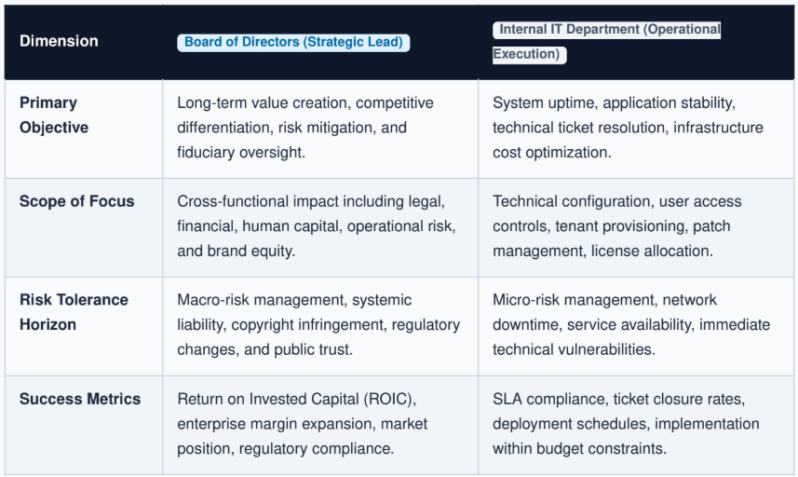
2. The Core Paradigm Shift: Operational Execution vs. Fiduciary Strategy
- To understand why the Board of Directors must lead the AI strategy, we must first delineate the fundamental
operational differences between the professional objectives of an IT team and the fiduciary responsibilities of
a corporate Board. The misalignment of these objectives during an AI rollout can lead to systemic structural
failure.
3. The Unique Perils of the M365 and SharePoint AI Deployment
- Deploying AI inside Microsoft 365 and SharePoint is uniquely dangerous compared to deploying standalone or isolated AI systems. SharePoint functions as the historical "digital attic" and central repository of an organization. It contains decades of legacy data, board minutes, unredacted payroll information, internal litigation strategies, proprietary design blueprints, and informal employee communications.
3.1. The "Just-Enough Access" and Over-Sharing Crisis
- Microsoft Copilot respects existing user permissions within an M365 tenant. If an employee has access to a file, Copilot can ingest that file to generate text, answer prompts, and synthesize summaries. In theory, this sounds secure. In operational reality, it is a vulnerability.
- Most organizations suffer from severe permission drift: folders marked "Shared with Everyone" or "All Internal Staff" contain sensitive executive compensation details, pending M&A files, or disciplinary records that were misconfigured years prior.
- Before AI, this was managed through "obscurity"—if a regular employee didn't know the exact file path or filename, they would never find the document. However, an AI assistant queries data semantically. An employee can simply type: "Summarize the recent discussions regarding departmental layoffs and restructuring plans." The AI will instantly search all accessible SharePoint sites, extract the text from an orphaned, incorrectly shared HR document, and deliver a coherent summary. The IT department views this as "working as designed" because the technical permission matched the system configuration. The Board, however, must view this as an unacceptable operational and cultural crisis.
3.2. Automated Outbound Leakage and Regulatory Liability
- When enterprise AI models process internal data to draft emails, client presentations, or vendor contracts, they can inadvertently introduce massive legal liability if left unguided by corporate policy. Under strict regulations such as GDPR, CCPA, and emerging global AI acts, the board is held personally liable for systemic data misuse. If IT deploys Copilot without a board-level compliance directive, the system may process protected PII (Personally Identifiable Information) in ways that violate consumer rights, triggering statutory fines where the financial penalty scales into millions of dollars.
- Critical Governance Insight: The Illusion of Technical Sufficiency
- IT departments are designed to check boxes: Is the license active? Yes. Is the agent installed? Yes. Does the API connect? Yes. They cannot, by design, determine whether the company should legally or ethically trust an automated system to draft legally binding supply-chain contracts or evaluate internal performance reviews. Tech capability does not equal strategic authorization.
4. The Four Pillars of Board-Led AI Governance
- To safeguard the organization while maximizing the immense economic upside of generative AI in M365, the Board of Directors must institute a four-pillared governance framework that directs and constrains the IT department's tactical implementation.
- Pillar 1: Risk & Liability Governance (Fiduciary Shield)
- The Board must establish clear legal boundaries regarding intellectual property (IP). If an AI tool utilizes
- corporate data stored in SharePoint to generate commercial output, the Board must ensure that contract
- indemnifications with vendors (like Microsoft) protect corporate IP from public model training. Furthermore, the
- Board must define the organization's threshold for AI "hallucinations" in customer-facing outputs, establishing
- mandatory "human-in-the-loop" protocols for high-consequence business lines.
- Pillar 2: Capital Allocation & Realized ROI (Financial Accountability)
- M365 AI licensing is expensive. A standard rollout across a global enterprise represents a significant, recurring operational expenditure. IT often measures success by adoption rates (e.g., 80% of staff opened Copilot this month). The Board must demand metrics focused on real value creation. Are these tools compressing the sales cycle? Are they driving down the cost of goods sold (COGS)? The Board's role is to tie AI expenditure to explicit margin expansion, rather than technical adoption vanity metrics.
- Pillar 3: Ethical, Cultural, and Human Capital Strategy
- AI deployment changes workforce dynamics.
- If Copilot saves every worker 6 hours a week, how is that newly freed capital redeployed?
- IT cannot answer this. The Board, working with executive leadership, must architect the organizational design:
- Upskilling programs, workforce adjustment strategies, and clear ethical guidelines regarding automated employee monitoring.
- Additionally, the Board must prevent algorithmic bias from creeping into internal evaluations via AI-driven sentiment analysis of SharePoint communications.
- Pillar 4: Strategic Market Positioning
- AI is a disruptive force that can render existing products and service offerings obsolete overnight. While IT focuses on internal software deployment, the Board must constantly scan the external horizon. How can the data assets locked inside SharePoint be leveraged as a proprietary moat against new digital-native market
- entrants? The strategy must focus on turning the corporate data repository into an engine of unique market power, not just a shared storage drive.
- Pillar 1: Risk & Liability Governance (Fiduciary Shield)
5. Implementation Roadmap for the Board
- To smoothly transition ownership and execute this strategy effectively, the Board should adopt a phased approach:
- Establish a Cross-Functional AI Governance Committee (AIGC): This committee must report directly to the Board and include representatives from Legal, Risk, HR, Finance, and Operations, with IT serving as a technical advisor.
- Conduct a Semantic Data Audit: Instruct IT to execute comprehensive automated data discovery within SharePoint to identify and isolate sensitive, misconfigured legacy files before Copilot is activated globally.
- Issue a Corporate AI Constitution: Publish a high-level corporate policy defining what categories of business data can be processed by generative AI, and where human sign-off is non-negotiable.
- Implement Tiered Value Tracking: Re-allocate budgeting metrics so that continued license expansion is contingent upon proven business unit efficiency gains, rather than raw application utilization.
6. Conclusion
- Delegating AI strategy to the IT department exposes an organization to profound legal, operational, and financial vulnerabilities, while simultaneously underutilizing a transformative corporate asset. IT excels at technical execution but lacks the mandate and scope to manage macro fiduciary liabilities. The Board of Directors must assume active control, steering the organization through this epochal transformation by defining the boundaries, measuring the value, and governing the risks of the enterprise AI landscape.